
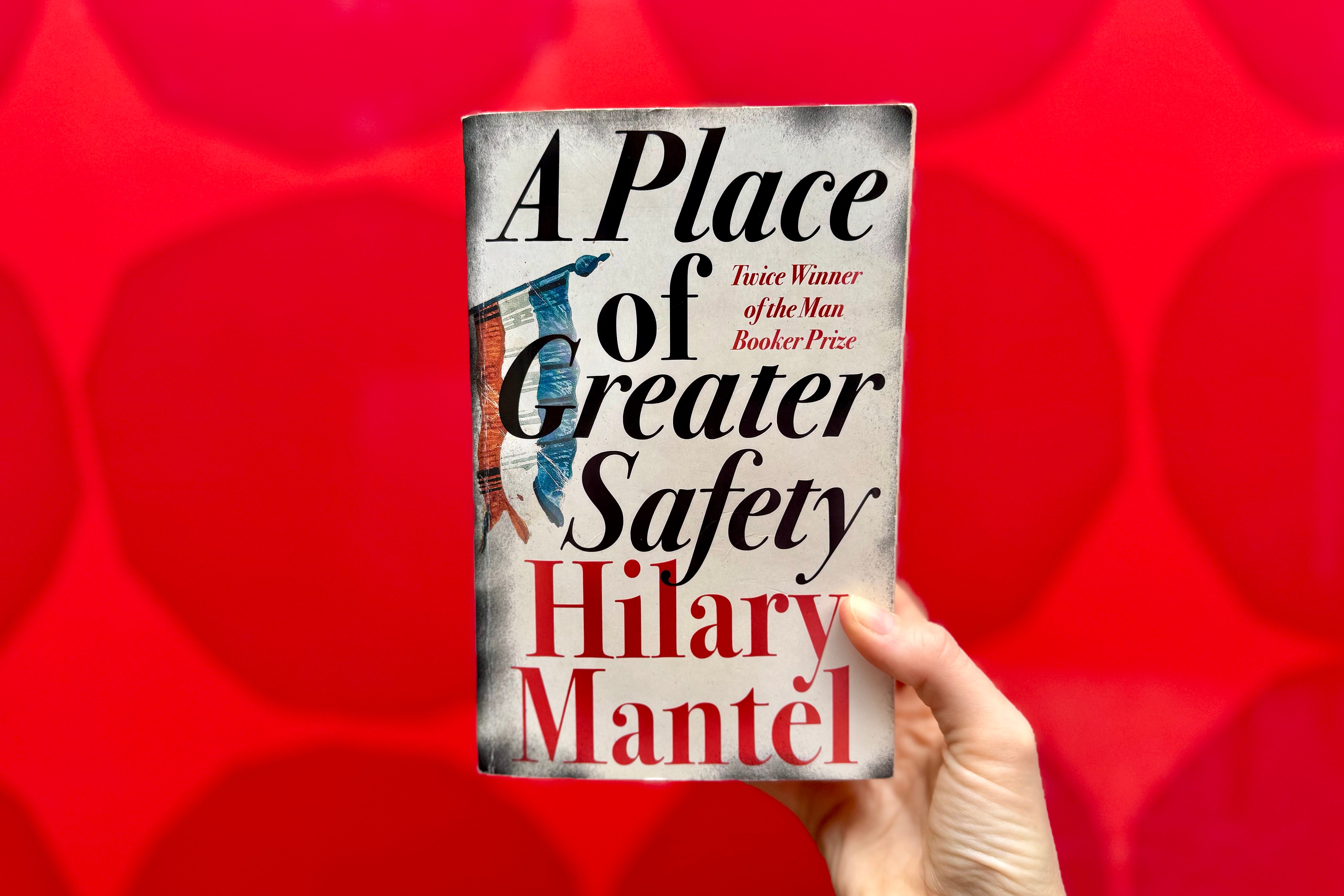
A Place of Greater Safety, by Hilary Mantel
Hilary Mantel’s epic doorstopper brings the French Revolution to life — in intimate, violent, and inescapably human detail.

(Hello! Been a while. Doing my best to keep documenting my reading here, but also just trying to be human. Thanks for sticking around.)
***
In the 2020s, elections are won — it is said — on the price of eggs. In the 1780s and 90s, the French revolution ignites by the price of bread. And so it goes.
A Place of Greater Safety captures the intimate lives of three key figures of the French revolution: Georges Jacques Danton, Camille Desmoulins, and Maximilien Robespierre. We begin a generation earlier, with the trials of their parents. We follow their journey through school, discover how their origins mould them into very different characters headed, ultimately, down a similar path. We see them build relationships and careers are lawyers; watch their complicated and evolving relationship with the ideas — and finally, the actions — that sparked the revolution. And we end, after almost 900 pages, with their final days.
I heard this book recommended by Annie Lowrey when she appeared on the Ezra Klein podcast. Klein (her husband): “Never have I been so frequently recommended a book in my own home.” I bought it, perhaps, mostly, to share in this fantasy domestic world where two writers discuss economic theories and impress books upon each other.
But, where to begin?
Mantel is a master. She is be the best fiction writer I have read in a long time. It is not just that the plot is gripping, the tension is carefully crafted, or the structure is complex but ultimately clean. For me, it’s the sentences.
I remember Stephen King lamenting in On Writing that novelists are so rarely asked about their sentences. I don’t rate King’s sentences all that much, but Mantel’s are a dream. You can sense, as you read, that this is a hostess truly at ease in her world. She fully inhabits the romance, the violence, the desperation, the surrender of the time she documents. Her grasp on the more technical elements of writing is so masterful that she can flip between characters, tones, and point of view like a flip book animation, where each sketch adds up to a bigger picture. While some writers get too cute with style experiments, Mantel is so at home as a writer that her playful experiments feel like adventures, not anarchy.
Here is a writer at home both with her subjects and her tools.
Peeling back the craft, this is a classic tale of ambition — of how ambition almost always succumbs to the second law of thermodynamics. Mantel depicts, with deep human insight, how the courage to revolt on behalf of a starving nation can so easily morph into the comfort of entrenched power, original ambitions erased.
It is also, of course, a tale for our times. Inequality in 1780s France is extreme; the Queen is procuring diamonds while the people live off burnt, moulding husks of bread. The people live, die, and revolt because of bread, while the few at the top are preoccupied with matters of power: who to placate, who to silence.
See this journal entry (a real one) by Robespierre:
What is our aim?
The use of the constitution for the benefit of the people.
Who are likely to oppose us?
The rich and corrupt.
What methods will they employ?
Slander and hypocrisy.
What factors will encourage the use of such means?
The ignorance of ordinary people.
When will the people be educated?
When they have enough to eat, and when the rich and the government stop bribing treacherous tongues and pens to deceive them; when their interests are identified with those of the people.
When will this be?
Never.
As inequality rises across the West, and even the most liberal of democracies succumbs to state capture by entrenched interests, this is a tale of history that reads like a dystopian warning for our own times.