
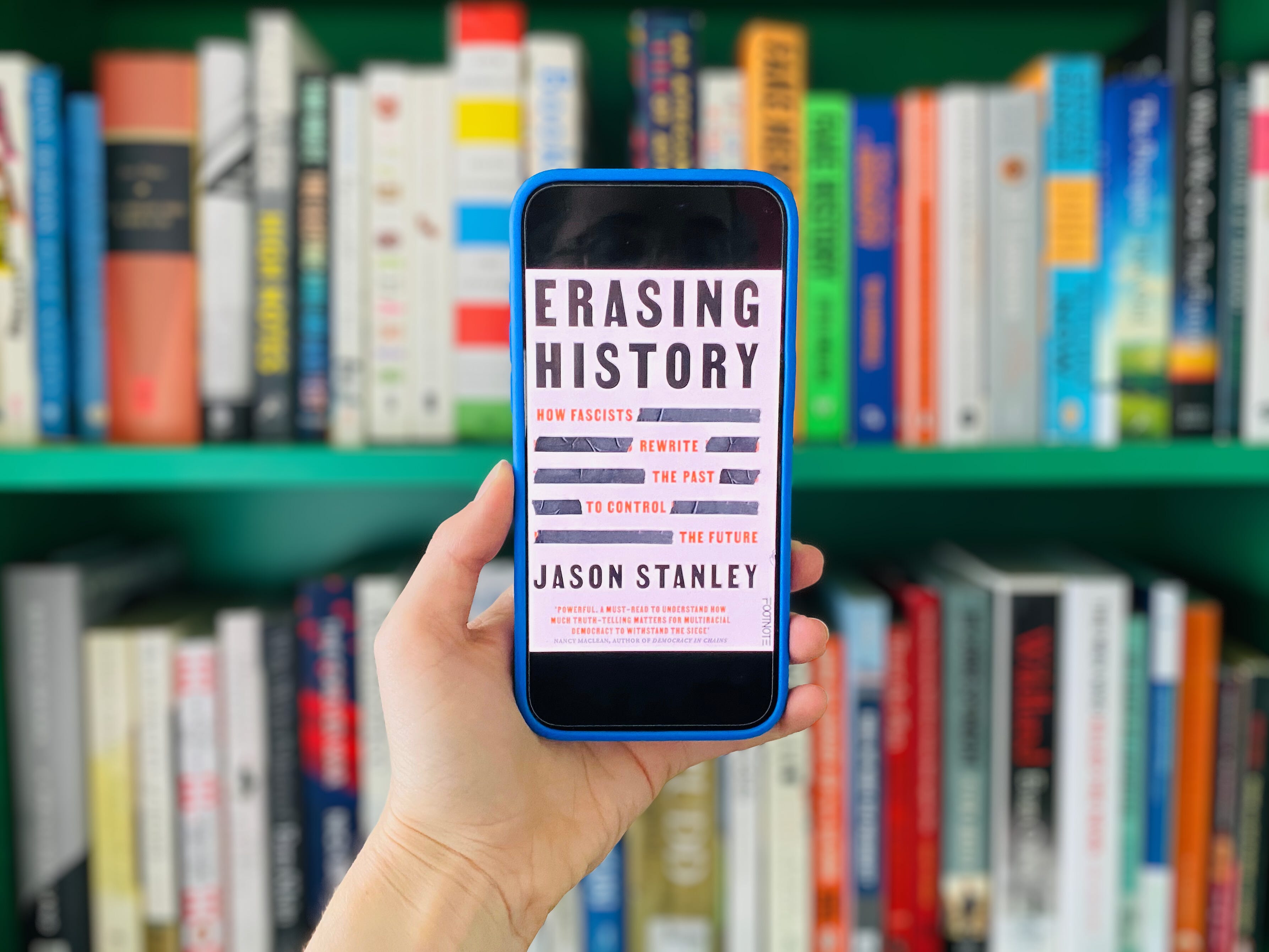
Erasing History: How Fascists Rewrite the Past to Control the Future, by Jason Stanley
“The professors are the enemy.” — J.D. Vance

I’m beginning to think fascist should be a contender for the 2026 Word of the Year. We did not even make it three days into the new year before the despotic leader of the ‘free’ world was raining bombs and kidnapping heads of state and bragging about it on his social media.
The most shocking characteristic of the far right/MAGA/Republican party’s fascism is not how thinly it is veiled — how poor the disguise — but rather how it is simply not disguised at all. This is fascism in plain sight. The F word is used primarily as a pejorative by the Left, and yet we’ve hardly seen the Right reject it. It’s not that they embrace the label, but they certainly aren’t denying it.
The MAGA ideology is not a politics of creation but one of grievance, destruction, and erasure. And that’s fascism in a nutshell: the desire to redirect blame, delete inconvenient truths, rewrite the story or a nation or people.
This is, unsurprisingly, the central premise of Jason Stanley’s latest book, which compellingly lays out all the insidious ways in which fascist elites, now and then, rewrite the story of a nation. The way Stanley contrasts the actions of fascist regimes in the distant and more recent past with those of the MAGA movement is striking. We’ve heard variations on these themes for the last ten years, at least, and yet they still make my jaw drop.
Education as social good
The book spends a lot of its time in the classroom, narrowing in on how fascists interfere with educational institutions, because, of course, children are the natural starting point for rewriting a culture. Yes, in the short term, efforts at rewiring adult minds are necessary, whether by broad misinformation (looking at you, social media) or outright, targeted threats to dissidents, but a lasting cultural rewrite must begin with children. All people are impressionable; children especially so.
I remember reading an article by a South Korean teacher who infiltrated North Korea to teach high school students. She was shocked by their textbooks, which simply praised the country’s leader (I think it was Kim Jong Il at the time) and demonised McDonald’s burgers as the epitome of the indulgent, corrupt, depraved West. The students, she explained, had no idea how to think critically — how to think, even. She would attempt to have them practise reasoning by asking them to justify their arguments, and they simply could not. They didn’t understand the assignment. Reason and critical thinking are not natural abilities we are born with. They must be taught if we wish to save people from those who wish to exploit them.
Education is not neutral — it is a social good, a net benefit (when used well). “Virtually every advancement that society has made towards greater equality began with educators,” says Stanley. This is why fascists see education as both the biggest threat to their authority and also their best bet for changing a culture from a pluralistic, democratic one to an unquestioning, authoritarian one.
“To resist the slide into cruelty is perhaps the most important educational goal of a people,” says Stanley. I’d refute this, just a little. I think the goal of education is to work at undoing cruelty, which has never been absent in our history. Yet regardless, the goal of fascists is to perpetuate, rather than erase, cruelty. “This is why fascists attack teachers,” Stanley writes. “Democratic education enhances human flourishing, supports human dignity, and shapes children into critical, thoughtful, generous, empathetic citizens.”
A nation of people who do not trust their own intelligence, who have no faith in their own abilities to think is a nation reliant on others for their thoughts. And in that case, it is not the best-reasoned argument that wins out, but the loudest or the angriest. Trump has won.
Education as identity
But education is not simply a tool for teaching critical thinking. Erasing History builds a compelling case for the idea that education is not simply a tool for enabling individual social mobility or material gains, but is a social good in its own right: a passer-on of a people’s own history and identity. When people have a true and common understanding of their history and identity, they can move forward in a positive direction. Without it, a national or cultural identity can be quickly destroyed. Stanley refers to Israel’s intentional destruction of Gaza’s educational institutions as “scholasticide” — a way of erasing history, and therefore identity. “No democratic culture can rest upon such an impoverished education,” says Stanley. “Without a common understanding of reality and a common sense of history, social and economic equality are impossible.”
Beyond destruction, education’s ability to actively shape young people’s identity is what makes it the perfect tool for fascists to exploit. In this way, a child’s education can represent either a weapon used against her, or her own salvation against tyranny. But it can be only one or the other.
Educational institutions are becoming easy prey
Early childhood education is a frequent and logical target of authoritarian regimes (hello, “don’t say gay”), but universities almost never escape the wrath of these regimes either (hello, Ivy League!). Stanley calls universities the “canaries in the coal mine” of fascist regimes: the first to come under fire. This is because fascists fear the truth. They fear ideas; they fear the people who read and think and teach.
None of this is news, and yet the idea of universities as the first battleground for freedom concerned me. It made me worried for my own country, Australia, whose universities have been hollowed out not by nationalist ideology so much as a neoliberal economic agenda. Australian universities, which have a long and egalitarian legacy in the country, are barely holding on. They are haemorrhaging students and staff. They are cutting courses and relegating core functions to AI chatbots. An Australian fascist, should they claim power (a not at all unlikely occurrence given our tendency to follow in the footsteps of the US, about 20 years behind them), would merely have to blow and watch the higher-ed house of cards come tumbling down.
The five themes of fascist education
Stanlely outlines five key themes of fascist education:
1 — National greatness: No inconvenient truth should get in the way of the legacy of the best and strongest and most deserving nation in the world. Students of history are familiar with Hitler’s retelling of the German legacy, but Stanley had some fascinating insights about how America’s toxic exceptionalism narrative is working against it today:
“Just as German education in the Weimar period and before embraced an inflated conception of German national identity that paved the way for national socialism, the widespread devotion to American exceptionalism leaves the United States keenly susceptible to the advances of a disciplined and informed fascist movement of its own, while obscuring this very weakness from its citizens, since American exceptionalism holds that the United States is uniquely resistant to all harmful influences, including fascism.”
2 — National purity: “We look like X, and sound like X, and believe in X.” This is J.D. Vance’s ‘heritage Americans’ in a nutshell.
3 — National innocence: We are the victims, and we’ve never done anything wrong. “The fight against fascism is also a fight against fake history,” says Stanley. For most nations, both national purity and national innocence are lies.
4 — Strict gender roles: Gender is binary, women make babies. What’s interesting about the modern MAGA movement is that, other than your bog-standard grab-em-by-the-pussy misogyny, the modern obsession with Tradwives and SAHGs (stay-at-home girlfriends) seems to be somewhat organic, rising up from the people rather than the elites. Who knows, maybe it’s all a targeted bot campaign, but this one feels more organic to me, which is almost… worse.
5 — Vilification of the left: Anyone opposed to the regime becomes a Marxist or a Communist. Today, that might be Antifa or domestic terrorists, but there’s no shortage of this rhetoric. “Fascist education is education for mobilization,” says Stanley. “Like fascist propaganda, it prepares students for violence.”
When Stanley lays this out so clearly, it’s hard not to despair. These five pillars are the ideological core of MAGA’s endless misinformation campaigns. At this point, we have to ask ourselves: how can we counteract the damage being done? Is it too late to reverse the tides?