
I thought this was a book about Russia. It was about the USA.
Turns out autocracy is no longer just a subject for books about "other places."

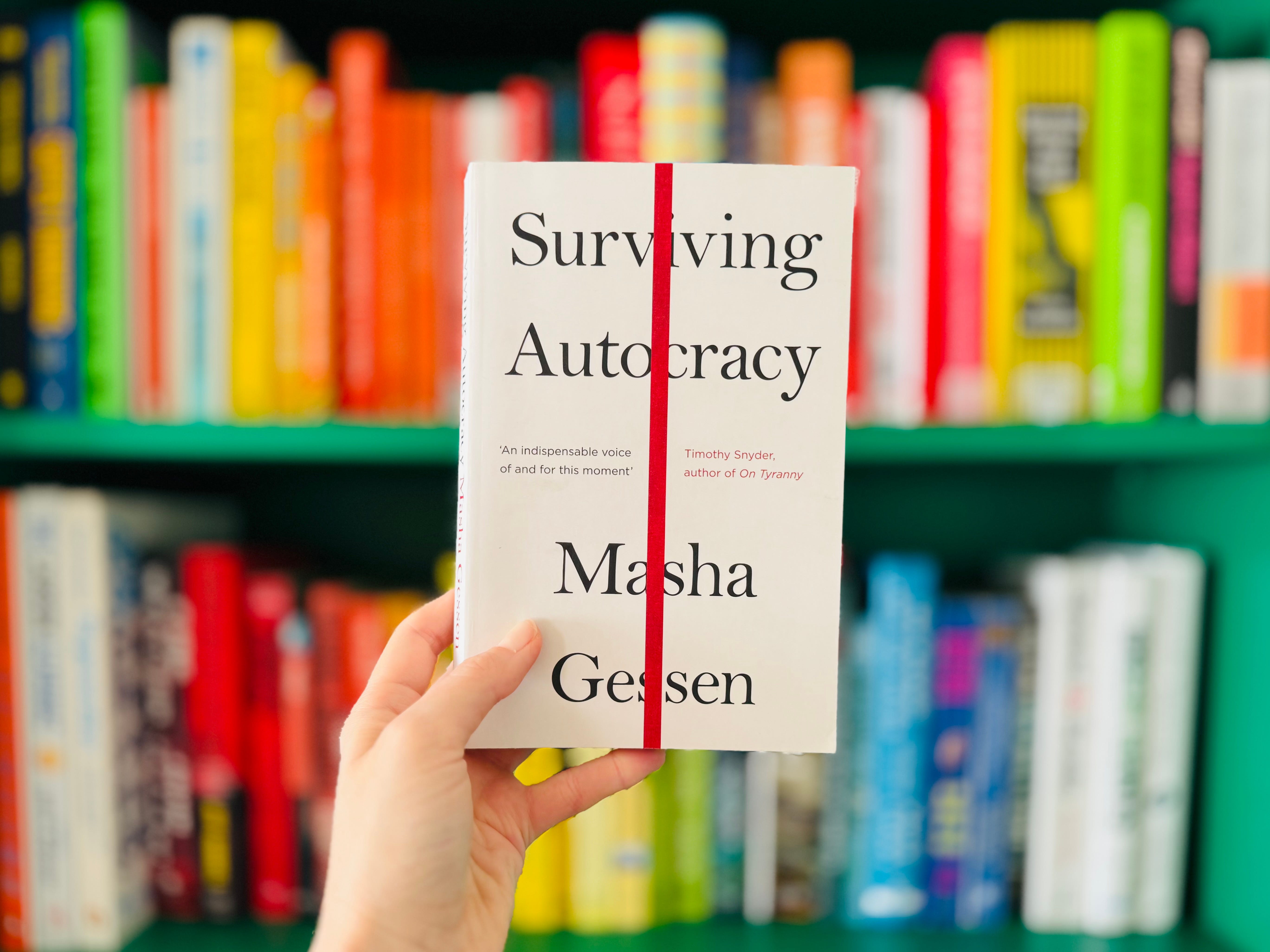
I am naive.
I bought this book imagining it had something to do with Gessen’s time growing up in the Soviet Union. I was wrong; it was a book written towards the end and shortly after the first Trump term — an attempt to reckon with that brief but irreversible period in American life.
This is ironic on two levels: first, that I assumed a Russian-born author writing about surviving autocratic regimes was writing about Russia, not the U.S.; and second, that I was reading it in the second year of the second Trump term, when it appears that the entire established world order is tipping over, a milk cup in the grasp of an unsteady toddler. What Gessen chronicles as abuses of power in the first Trump term are both resoundingly similar and also far tamer than what we are seeing today. If the first term was Trump testing the waters, the second term is him pushing everyone into the deep end.
Particularly interesting to me are Gessen’s insights on language — how it is abused by autocrats, how its absence or lack of shared definition erodes power and cohesion among those without political power. “So much of our lives depended on words that meant so little to the man who said them,” says Gessen, referring to Trump’s callous and careless manner of speech during his first term.
It is amplified by the media, which often unquestioningly accepts the foundational language or frameworks underlying Trump’s assertions, even as it tries to rebut them. Most anti-Trump rhetoric stoops to his level, debating him with his own assumptions, rather than redirecting the conversation towards higher ground.
Gessen speaks of the political ambition of autocrats, noting that it is far removed from political aspiration. Ambitious tyrants like Trump want everything, and they want it now — but theirs is not a moral calling. It is simply greed.
Many people, institutions, and traditions failed to uphold an acceptable standard of dialogue and restrain his power during the first term — to say nothing of the second term.
Writing of the former, Gessen says: “the first three years have shown that an autocratic attempt in the United States has a credible attempt of succeeding. Worse than that, they have shown that an autocratic attempt builds logically on the structures and norms of American government: on the concentration of power in the executive branch, and on the marriage of money and politics.”
This is the biggest long-term danger of both Trump presidencies. Even if free and fair elections are called in 2028, the seed has been planted. Power-hungry people on all sides have seen what can be done by a bully who knows no bounds. The box has been opened.