
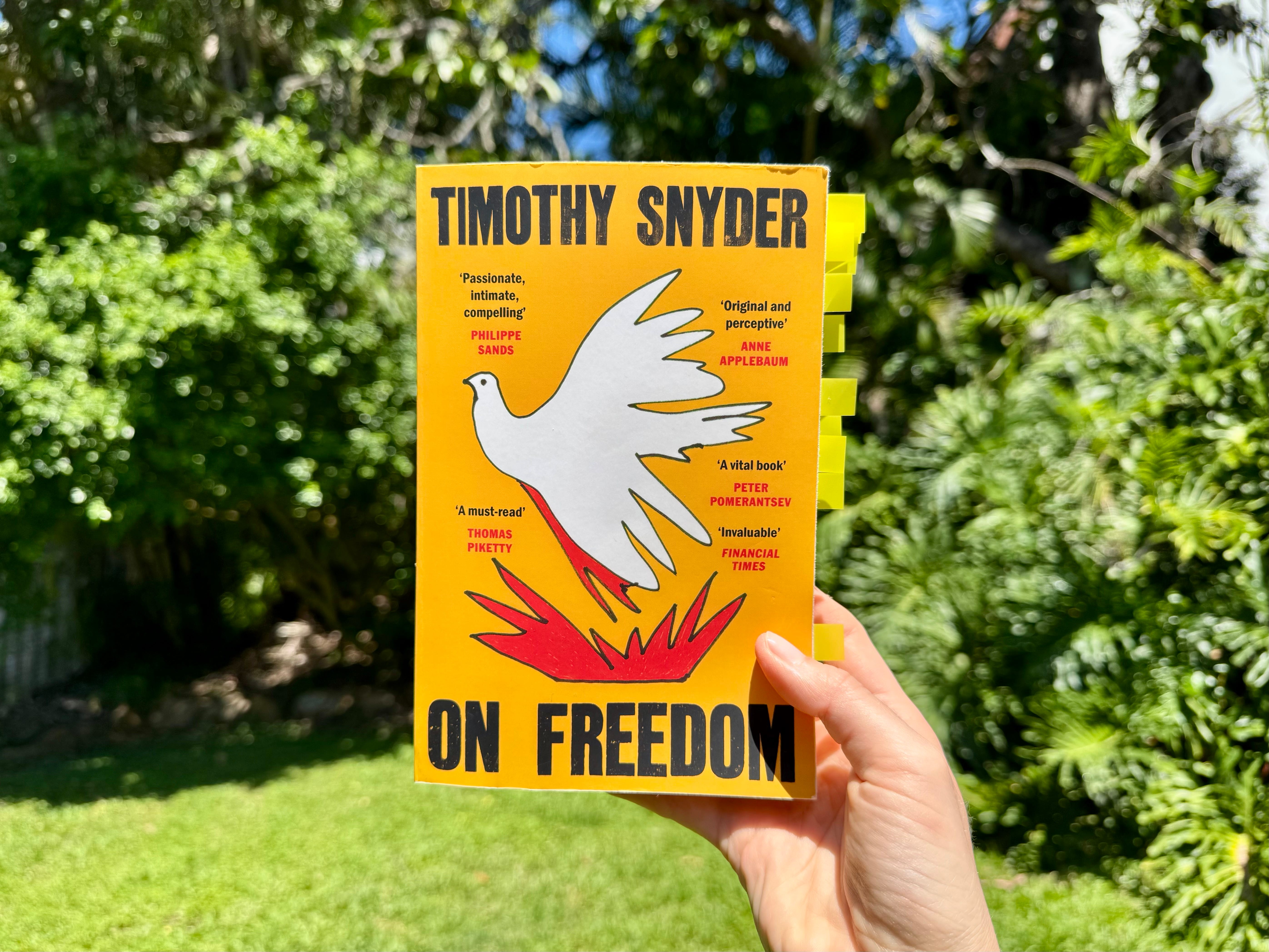
My Favourite Book of 2025: On Freedom, by Timothy Snyder
This beautiful, intimate book about what freedom really means is the book we all need as the term becomes increasingly abused by the far Right.

“If a book about freedom doesn’t mention childbirth, you don’t have to read it.” — Timothy Snyder
I picked up this book expecting a history lesson, but it gave me so much more than that. Snyder’s central premise is that our current notion of ‘freedom’ in most of the Western world (which has largely been claimed by the political Right) is one of ‘negative freedom’, or ‘freedom from’ — specifically, freedom from a powerful, interfering government. Many other non-right-wing movements in history have defined freedom in a negative sense, but our modern definition of freedom has been largely defined by the rise of neoliberalism (”the government is the problem”), the unquestioning quest for free markets, and the mostly false idea that unregulated capitalism is the best path to prosperity for all.
Instead Snyder advocates for and eloquently defines ‘positive freedom’ — one that begins with birth and lasts a long and fulfilling lifetime. Achieving positive freedom for a nation or the world requires not no government, but an able one: a government, society, and economy that supports the raising of babies, the education of children, the enabling of adults to live a life of their own choosing — not one predetermined by circumstances or the delusions of ideological leaders.
‘Freedom from’ is an ill-considered individual concept, the idea that each of us would be perfectly fine if other people (and people in charge) would just leave us alone. Yet no human being can achieve a good life alone. Without the love and support of other people, they wouldn’t make it past their first day on earth. In Snyder’s own (paraphrased) words on a CBC Ideas podcast, “If a book about freedom doesn’t mention childbirth, you don’t have to read it.” (As he notes, this rules out most of them.)
The history of negative freedom is long and dark. In the US alone, its origins are telling. “If your only obstacle in life is the government,” says Snyder, “then what does that say about you?” Those who fear government interference are those with something — slaves, property, profits — to lose. Meanwhile, those who need government support most (at the time, people of colour, women, children) were themselves desperately unfree, doing the active work required to make the people at the top ‘free’.
Positive freedom entails not removing but building. Building infrastructure, medical systems, welfare programs and other necessary safety nets that allow people to stop worrying about the basics of survival and instead live long and fulfilling lives. In some ways this ‘build’ philosophy has echoed other great books I’ve read this year around supply-side progressivism, including Abundance and Breakneck. But this book is more than political; it is deeply personal, chronicles fascinating moments in Snyder’s own, journeyed life, and reads in a meandering and philosophical way that demands full attention and slow reading.
This is not the kind of book you leave to AI summaries (most books are not, but this one especially). It is tender and compelling in all the ways that the current conversation around government efficiency and shutdowns and premiums and policy are not. This is a book that puts humanity back into the conversation around government, economics, and society.
I’ve come to the conclusion that this was the best book I read in all of 2025.