
The AI industry is gobbling us up
This depressing book reveals how, in search of the superhuman, the AI industry is devouring real humans.

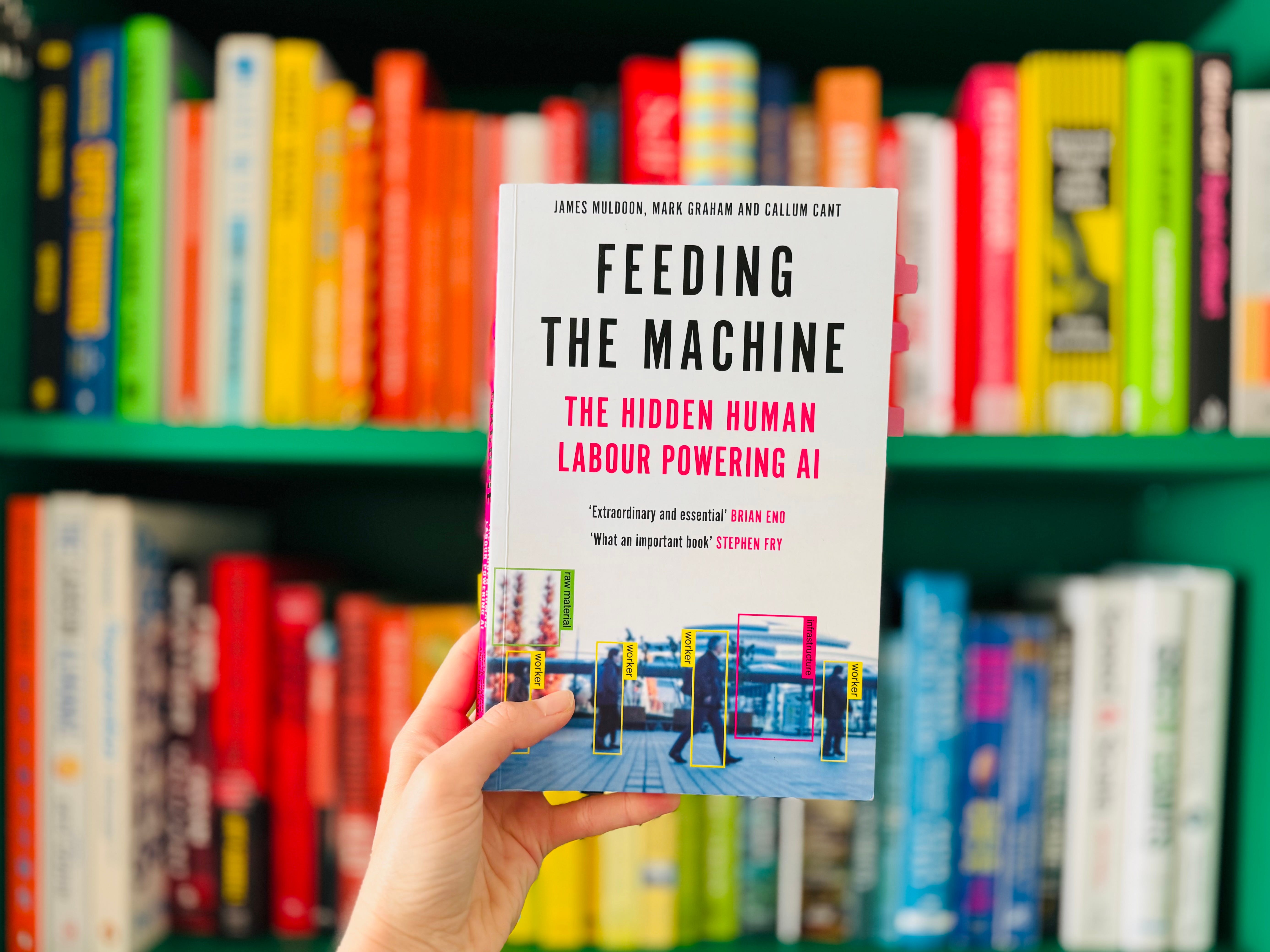
Perhaps it’s a byproduct of growing up with the Internet, but I distinctly remember the day it dawned on me that ‘the cloud’ was in fact just a bunch of servers sitting in data centres, connected to the rest of the world via — very real — cables. What appeared to me as virtual did, in fact, have a physical form — I just couldn’t see it.
Fast-forward to the AI buzz of today. In the excitement of texting with LLMs that sound human, or watching robots kick footballs, we have mostly turned a blind eye to the fact that it is humans who ‘feed’ the AI machine, whether it’s writers ‘and artists’ work being used to train models, or exploited workers in the Global South forced to view and tag all softs of images, footage, and text in order to teach the AI.
“Contrary to what the Ancient Greeks believed, technology is not a gift from the gods. It is forged by human hands and indelibly marked by its creators’ world.”
We are exploiting people to create a machine that does, for the most part, what humans can already do.
“Today… Machines create art, compose music and write poetry, while countless humans are forced to work like robots, toiling in monotonous low-paid jobs just to make such remarkable machines possible.”
This is the basis of Feeding the Machine, which I picked up mid-way through last year but only got to reading last week. It presents a compelling profile of the various types of people at the different stages of the AI supply chain — content moderators, data annotators, data centre technicians, artists whose work is stolen, Amazon workers whose daily work schedules are dictated and monitored by AI, software engineers, venture capital investors.
I had thought the book would focus more on the exploitation of people earlier in the funnel, but I thought this structure was still an effective way to show how the sausage is made. The most shocking profiles are, of course, those of the workers in the Global South, whose jobs as content moderators or data annotators are impossibly gruelling and incredibly traumatising — they are either bored to the point of breakdown by the endless tagging of street scenes or basic images; or, they are traumatised beyond repair by the constant barrage of violent rape and bloody murder videos they are forced to watch in rapid succession.
“If AI is understood as an extraction machine, then we are the raw material.”
“We, human beings, are the often-hidden force that powers AI — both physically with our labour but also intellectually through AI ingesting and synthesising our collective intelligence… Without us, AI ceases to function. It is only through the constant supply of human labour — annotating datasets, coding software, repairing serves, creating new paintings and literature and keeping supply chains functioning — that AI continues to exist.”
No matter how much they try to evade it, these workers’ exploitation is squarely the responsibility of the new breed of AI companies taking over the tech world. The authors paint an insightful picture of the new dynamics of the tech scene, making it clear that this new generation of AI companies is nothing like the last generation of tech companies. The latter were scrappy startups launched out of garages and university bedrooms. The former are huge capital-guzzlers that need shocking amounts of ‘compute’ (computing resources — basically, energy and water) to function.
Where software defined the previous era of value creation, hardware defines this one. And hardware is expensive. That’s why these new companies can only exist with the help of big backers who own the computing hardware that can accommodate the sheer scale of these models. These backers happen to be (surprise, surprise) the previous generation of big tech companies. If tech wasn’t a monopoly already, it certainly is now. The power of tech companies is consolidating further.
Beyond market monopolies and the way they harm consumers, there are also the human implications of the final AI product. As the authors note, “AI has become the focal point of competing ideas for how our future will develop.” Only those with power and resources currently have a say in the way AI gets developed, and it’s not looking good. “Corporations see dollars signs,” the authors say. “States see military hardware and competitive economic advantage. What seems unlikely is that these interests will lead to AI being developed in ways that benefit humanity.”
Depressing, yes, but it is important to understand the human agency at play here. “AI is often viewed as an inevitable force that we must adapt to,” say the authors, “rather than a tool that we can consciously shape through our own actions.”
The authors believe the present-day social and environmental consequences of AI make a more compelling argument for better regulation than fear-mongering about superintelligence or eventual robot takeovers. I tend to agree. Indeed, the doomerism often propagated by industry leaders themselves is itself a distraction from the very real harms that current AI models are causing today.