
What a banned book can teach us about power, ignorance, and how history creeps up on us
Forty years on, The Handmaid's Tale remains a defiant book about remaining human in an inhumane world.

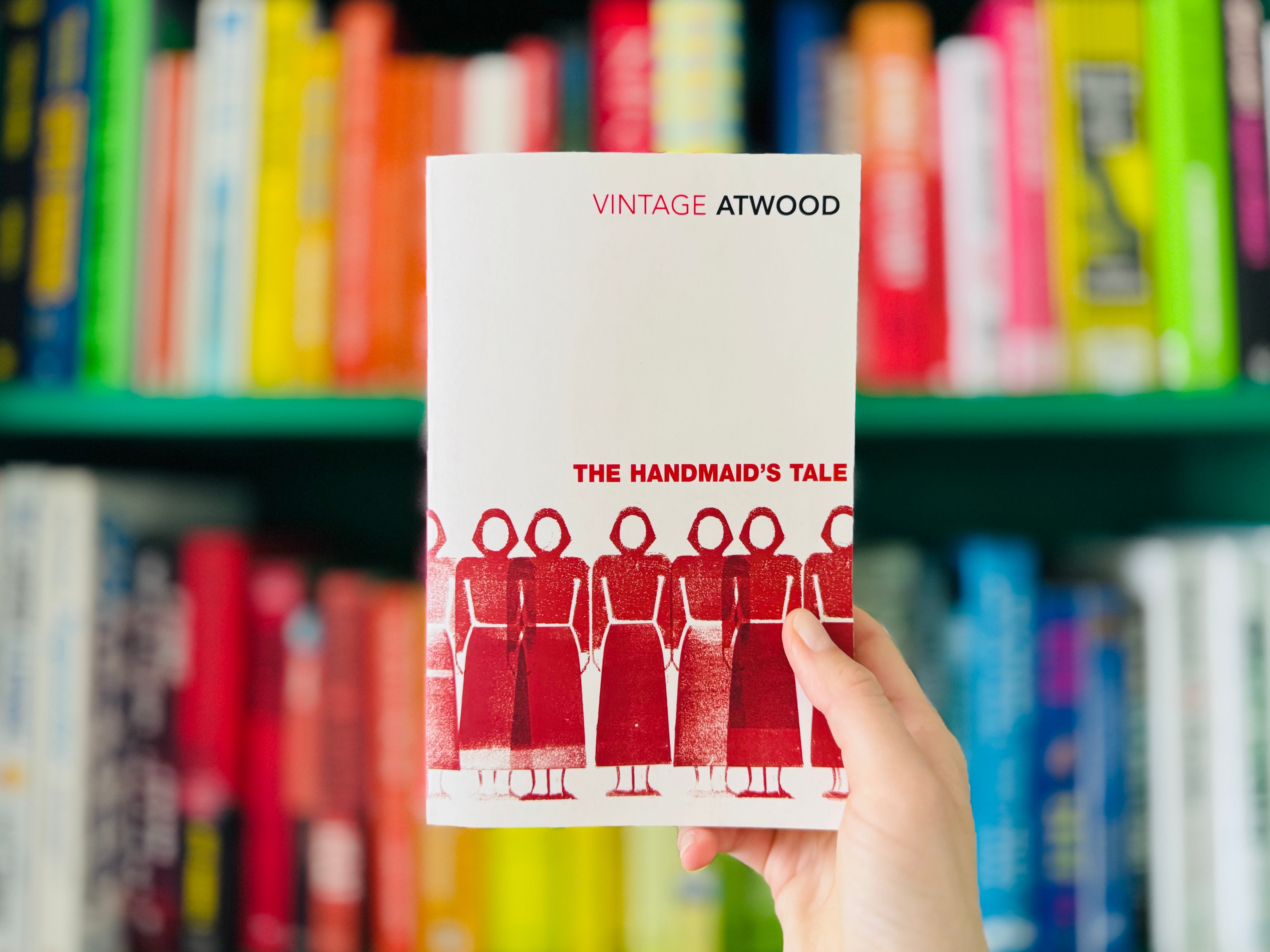
“I know where I am, and who, and what day it is. These are the tests, and I am sane. Sanity is a valuable possession; I hoard it the way people once hoarded money. I save it, so I will have enough, when the time comes.”
There is probably nothing original left to say about The Handmaid’s Tale, a classic dystopian novel by a writer with a habit of seeing and labelling the cruelty and injustice that others would rather look away from; who understands the preciousness of freedom and was warning about it even when much of the the world, in the 80s, 90s, and early 2000s, saw nothing but liberal democracy and ever-growing progress on its horizons.
I recently listened to Atwood on Kara Swisher’s podcast. At 86, Atwood was sharp, perceptive, and her usual no-nonsense, down-to-earth self. I can’t quote this part exactly, but at one point, Swisher asks why Atwood made Gilead (the world of The Handmaid’s Tale) a religious state. “Well,” says Atwood, “the future looks like the past.” Nations and their people, Atwood believes, tend to fall back into familiar patterns. If you want to see where a country is going, try looking at where they’ve been. The Handmaid’s Tale was first published in 1985, and now look where we are.
Anyway, back to the book. Atwood takes us into the world of a repressive totalitarian regime not at the level of the village, or even the family unit, but right inside the white head wings of a single human being. Her writing is so authentic, the focal points so small (an itch, a glance, a slight movement of a finger), that you feel precisely what it means to be Offred, white wings in your peripheral vision, head down, vigilant always. You can feel the weight of the million eyes on your, of your restrained movements under the red gown, of the relief and oppression of getting to your tiny room at the end of the day. Through these tiny moments and sensations, Atwood tells a much larger story.
Under constant surveillance, Offred is afforded almost no privacy. And yet, at the same time, she is achingly lonely. She finds the tiniest of freedoms and indulgences; micro-movements and moments with which to save what is left of her dignity. Under the state’s dehumanising forces, she desperately clings to her humanity.
“I’ll take care of it, Luke said. And because he said it instead of her, I knew he meant kill. That is what you have to do before you kill, I thought. You have to create an it, where none was before. You do that first, in your head, and then you make it real. So that’s how they do it, I thought. I seemed never to have known that before.”
Part of what makes The Handmaid’s Tale so all-encompassing is not just the fact that Atwood is a masterful world-builder and storyteller, but the simple fact that she is a writer’s writer. Every sentence is crafted with care, refined with the ear of a writer whose foremost influence was poetry. Atwood understands the power of the humble Anglo-Saxon noun, the satisfaction of the tangible verb. Her sentences are disciplined, her descriptions, precise. Here’s a taste.
“Moira was like an elevator with open sides. She made us dizzy. Already we were losing the taste for freedom, already we were finding these walls secure. In the upper reaches of the atmosphere you’d come apart, you’d vaporize, there would be no pressure holding you together.
The book is ripe — perhaps overly so — with symbol and colour. There’s a whole lot of birds and the bees going on, and we are clued in to Offred’s physical loneliness with her heightened awareness of flowers, and bees, and eggs, and even Scrabble tiles.
“The minimalist life. Pleasure is an egg.”
Yet each of the book’s symbols of life and fertility is inseparable from those of bloodshed and violence. As a symbol of fertility herself, Offred is also the object of violence.
Once cannot miss the influence of Rachel Carson and the uprising of environmental sentiment that form the real-world backdrop to the writing of this book. Atwood is a longtime champion of progressive causes, although she refutes the ‘P’ word, claiming that the universe does not simply march forward toward justice).
Yet what is fascinating about The Handmaid’s Tale in particular is its exploration of the brutal consequences of a future without science and technology, rather than, as many in the progressive and environmental camps are wont to do, a world overrun by it. The Handmaid’s Tale is a reminder that it is not our mobile phones or algorithms that threaten our future so much as it is the people behind them. Technology arrives in fits and starts, but human cruelty has not had a break yet.